
MC7808: Linear Voltage Regulator for 8V Power Supply Design
In the realm of electronic design, achieving a stable and reliable DC voltage is a fundamental requirement for powering countless circuits. While switch-mode power supplies offer high efficiency, their complexity and noise can be overkill for simple, low-power applications. For a straightforward, clean, and robust 8V output, the MC7808 linear voltage regulator remains an exceptionally popular and effective solution. This integrated circuit (IC) exemplifies simplicity and reliability, providing a fixed 8V output with minimal external components.
The MC7808 is a member of the classic 78xx series of three-terminal positive voltage regulators. Its primary function is to take a higher, unregulated DC input voltage—typically within a range of 11V to 35V—and deliver a constant, precisely regulated 8V DC output. It is capable of supplying up to 1A of output current under appropriate thermal conditions, making it suitable for a wide array of low-to-medium power devices, including microcontroller boards, op-amp circuits, and small motors.
The key to its operation lies in its internal architecture. The IC contains a high-gain error amplifier, a temperature-compensated voltage reference, and a series pass transistor. The regulator continuously compares a fraction of the output voltage against the internal reference. Any deviation, caused by changes in input voltage or load current, is corrected by adjusting the conductivity of the pass transistor, thereby maintaining a steady 8V output. A significant advantage of this design is its inherent low output noise and minimal ripple, a characteristic where linear regulators outperform their switching counterparts.
Implementing an MC7808 in a circuit is remarkably simple. The basic design requires only two capacitors for optimal performance. An input capacitor (typically 0.33μF) is placed near the regulator's input pin to minimize input impedance and suppress high-frequency noise. An output capacitor (typically 0.1μF) helps improve the regulator's transient response and stability. For scenarios involving large load variations or long input wires, larger electrolytic capacitors (e.g., 10μF to 100μF) at both the input and output are highly recommended to ensure stability and filter low-frequency noise.
Despite its advantages, the linear regulation method has one major drawback: heat dissipation. The regulator functions by dropping the excess voltage between its input and output, and this energy is dissipated as heat. The power dissipated (P_d) is calculated as (V_in - V_out) I_load. For example, with a 15V input, an 8V output, and a 500mA load, the regulator must dissipate (15V - 8V) 0.5A = 3.5W of heat. This often necessitates the use of a sufficiently sized heatsink to keep the IC's internal junction temperature within safe operating limits, preventing thermal shutdown.
In summary, the MC7808 is the go-to component for designers seeking a no-fuss, low-noise, and dependable 8V power source. Its ease of use, proven reliability, and clean output make it an enduring choice in prototyping, educational environments, and commercial products where efficiency is not the primary constraint.
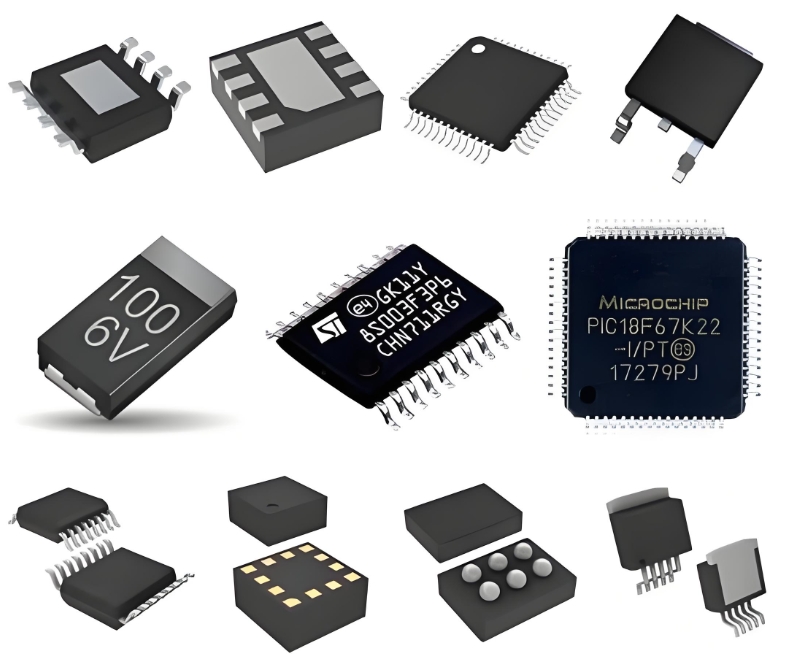
The MC7808 is a quintessential linear regulator, offering an optimal blend of simplicity, performance, and cost-effectiveness for 8V power applications.
Keywords:
1. Linear Voltage Regulator
2. 8V Output
3. Heat Dissipation
4. Low Noise
5. Three-Terminal Regulator